No crystalline solid found in nature is perfectly ordered. During crystal formation and even after a crystal has been formed, slight imperfections are inevitably introduced into its lattice. These imperfections, known as crystal defects, play a significant role in determining the physical and chemical properties of solids. Among the various point defects, the vacancy defect is the simplest and one of the most frequently encountered. Although it involves the absence of only a single atom or ion from the crystal lattice, its influence extends to processes such as diffusion, electrical conductivity, sintering, mechanical strength, and solid-state reactions.
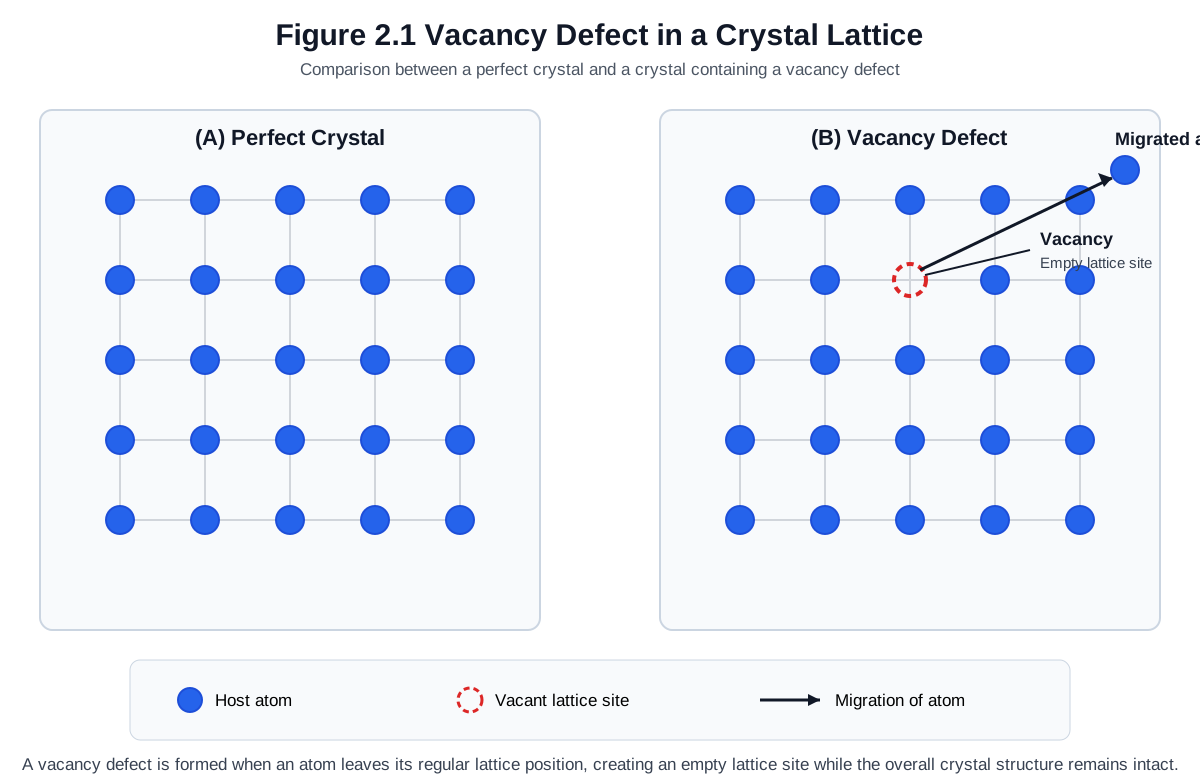
A vacancy defect is produced when an atom, ion, or molecule is missing from its regular lattice position, leaving behind an unoccupied lattice site called a vacancy. Since the defect is localized at a single lattice point, it belongs to the category of point defects. The neighbouring atoms generally remain at their lattice positions, although slight local distortion may occur around the vacant site due to the redistribution of interatomic forces.
Origin of Vacancy Defect
Vacancy defects may originate during the growth of a crystal or may be generated after crystal formation by external factors. In practice, the most common cause is thermal excitation. As the temperature of a crystal increases, its constituent atoms or ions acquire greater vibrational energy. Occasionally, a particle gains sufficient energy to leave its normal lattice position. If it migrates to the crystal surface or another energetically favourable location, an empty lattice site is created. This vacant position remains within the crystal and constitutes a vacancy defect.
Vacancies may also be introduced by rapid cooling, mechanical deformation, irradiation with energetic particles such as electrons, neutrons or ions, and during diffusion processes occurring in solids. Consequently, no real crystal is completely free from vacancy defects.
Atomic Description of Vacancy Formation
In an ideal crystal, every lattice point is occupied by its corresponding atom or ion. When one of these particles leaves its equilibrium position, the regular periodic arrangement is interrupted at that particular site. The neighbouring particles experience a slight imbalance in attractive and repulsive forces and may shift marginally towards the vacancy in an attempt to restore equilibrium. However, the overall crystal structure remains largely unchanged because the defect is confined to a very small region.
The formation of a vacancy requires energy because chemical bonds surrounding the lattice site must be broken or weakened. This energy is known as the vacancy formation energy. At equilibrium, the increase in entropy associated with the presence of vacancies compensates partially for this energy requirement, making a finite concentration of vacancies thermodynamically favourable at temperatures above absolute zero.
Equilibrium Concentration of Vacancies
The number of vacancies present in a crystal under equilibrium conditions depends primarily on temperature and the energy required to create a vacancy. This relationship is expressed by the Boltzmann equation:
$$
N_v = N \exp \left(-\frac{E_v}{kT}\right)
$$
where \(N_v\) represents the number of vacancies, \(N\) is the total number of lattice sites, \(E_v\) is the vacancy formation energy, \(k\) is the Boltzmann constant, and \(T\) is the absolute temperature.
The equation shows that vacancy concentration increases exponentially with temperature. Therefore, crystals contain relatively few vacancies at low temperatures, whereas a considerable number of vacant lattice sites are produced at elevated temperatures.
Characteristics of Vacancy Defect
The most distinguishing feature of a vacancy defect is the absence of a constituent particle from its normal lattice position without the addition of any extra particle elsewhere in the crystal. The defect is highly localized and does not significantly alter the long-range periodicity of the crystal lattice. Because vacancies provide empty lattice sites into which neighbouring atoms can move, they greatly facilitate atomic diffusion in solids.
In ionic crystals, electrical neutrality must generally be maintained. Therefore, vacancies are often produced in pairs or in combinations that preserve charge balance. For example, the simultaneous absence of one cation and one anion gives rise to the Schottky defect, which is discussed separately.
Effect on Physical Properties
Despite their microscopic size, vacancy defects influence many important properties of crystalline materials. The presence of vacant lattice sites increases the mobility of atoms and ions, thereby enhancing diffusion and accelerating solid-state reactions. High-temperature sintering of ceramic materials, alloy formation, and crystal growth are all strongly dependent on vacancy-assisted diffusion.
Vacancies also affect the density of a crystal. Since one or more particles are absent while the crystal volume remains almost unchanged, the overall mass decreases slightly, resulting in a reduction in density. In addition, vacancy defects may modify electrical conductivity, ionic transport, mechanical strength, creep behaviour, and the rate of recovery and recrystallization in metals.
Examples of Vacancy Defects
Vacancy defects occur in almost every crystalline material. Pure metals such as copper, silver, aluminium, and nickel contain thermal vacancies that become increasingly abundant with rising temperature. Ceramic materials and ionic crystals also possess vacancies, especially during high-temperature processing. In semiconductors, controlled vacancy concentrations are often important because they influence diffusion and the electrical behaviour of the material.
Importance of Vacancy Defect
Although a vacancy represents only the absence of a single particle, it plays an essential role in materials science and solid-state chemistry. Many industrial processes, including heat treatment of metals, powder metallurgy, ceramic sintering, crystal growth, semiconductor fabrication, and diffusion bonding, rely directly or indirectly on the movement of atoms through vacancy mechanisms. Understanding vacancy defects therefore provides the foundation for studying diffusion, defect chemistry, and the behaviour of real crystalline solids.
Summary
A vacancy defect is a point defect produced by the absence of an atom, ion, or molecule from its normal lattice position. Such defects arise naturally during crystal growth and become increasingly common as temperature rises. Their presence enhances diffusion, influences density and electrical properties, and governs many high-temperature processes in crystalline materials. Although vacancy defects are among the simplest crystal imperfections, they have profound effects on the physical behaviour and technological applications of solids.