Crystalline solids are composed of atoms, ions or molecules arranged in a highly ordered three-dimensional pattern known as a crystal lattice. Depending upon the regularity of this arrangement, crystals are classified as perfect crystals and imperfect crystals. Although the concept of a perfect crystal is useful for understanding the basic principles of crystallography, real crystals always contain defects. These defects significantly influence the physical, electrical, optical and mechanical properties of crystalline materials.
Perfect Crystal
A perfect crystal is an ideal crystal in which every lattice point is occupied by the correct atom, ion or molecule according to the crystal structure. The arrangement of particles is completely regular throughout the entire crystal without any interruption or defect.
Characteristics of a Perfect Crystal
- Every lattice point is occupied by the correct particle.
- The crystal possesses complete long-range order.
- No vacancies or extra atoms are present.
- No dislocations or grain boundaries exist.
- The chemical composition is perfectly stoichiometric.
- The crystal exhibits maximum symmetry.
- The physical properties are uniform in every identical direction.
Illustration of a Perfect Crystal
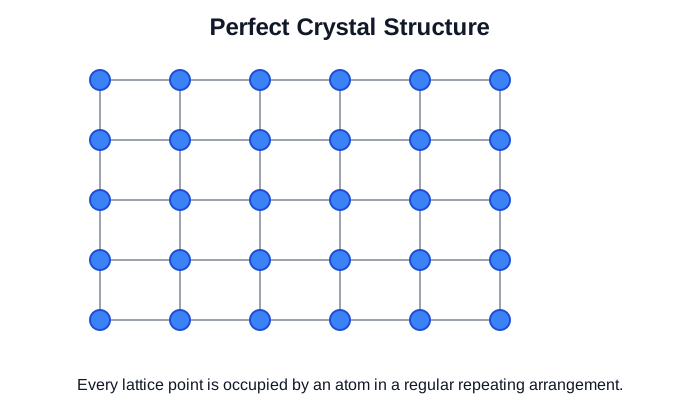
In a perfect crystal, each atom occupies its designated lattice position, producing a completely periodic arrangement throughout the crystal.
Limitations of a Perfect Crystal
A perfect crystal is only a theoretical concept. In practice, it is impossible to obtain a crystal that is completely free from defects because crystal growth always occurs under finite temperatures and real experimental conditions. During crystallization, thermal vibrations, impurities and mechanical stresses introduce irregularities into the lattice.
Imperfect Crystal
An imperfect crystal is a crystal that contains one or more structural irregularities known as crystal defects. These defects disturb the regular arrangement of atoms, ions or molecules within the crystal lattice. Almost all naturally occurring and synthetic crystals are imperfect crystals.
Characteristics of an Imperfect Crystal
- One or more lattice sites are disturbed.
- Crystal defects are always present.
- The crystal may contain vacancies, interstitial atoms or impurity atoms.
- The composition may deviate slightly from ideal stoichiometry.
- Mechanical, electrical and optical properties are altered.
- The extent of defects generally increases with temperature.
Causes of Crystal Imperfections
Crystal imperfections arise due to various reasons during crystal growth and subsequent processing.
- Rapid crystallization.
- High temperature.
- Mechanical deformation.
- Presence of impurities.
- Radiation damage.
- Thermal vibrations.
- Diffusion of atoms or ions.
Importance of Crystal Defects
Although crystal defects disturb the regular arrangement of atoms, they are extremely important because they determine many useful properties of solids. The electrical conductivity of semiconductors, ionic conductivity of solid electrolytes, diffusion of atoms, catalytic activity and mechanical strength of materials are all influenced by crystal defects.
- Increase ionic diffusion.
- Improve electrical conductivity.
- Control semiconductor properties.
- Influence mechanical strength.
- Enhance catalytic activity.
- Control optical properties.
Comparison Between Perfect and Imperfect Crystals
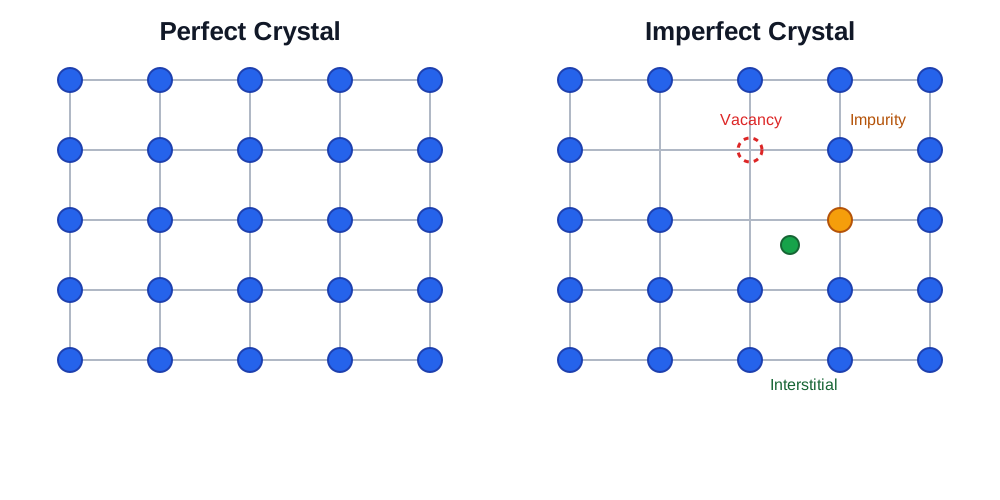
| Property |
Perfect Crystal |
Imperfect Crystal |
| Atomic arrangement |
Completely regular |
Contains irregularities |
| Crystal defects |
Absent |
Present |
| Stoichiometry |
Ideal |
May deviate slightly |
| Electrical conductivity |
Lower |
May increase due to defects |
| Mechanical properties |
Ideal |
Affected by defects |
| Existence |
Theoretical |
Real crystals |
Applications
- Design of semiconductor devices.
- Manufacture of ceramic materials.
- Preparation of solid electrolytes.
- Development of superconductors.
- Production of magnetic materials.
- Crystal engineering and nanotechnology.
Summary
A perfect crystal possesses complete periodicity without any structural irregularity, whereas an imperfect crystal contains defects that disturb the regular arrangement of atoms. In reality, every crystal contains defects because of thermal motion, impurities and crystal growth conditions. These imperfections play an important role in determining the physical, chemical, electrical and mechanical properties of crystalline solids.
Key Points
- A perfect crystal is an ideal concept.
- All naturally occurring crystals are imperfect.
- Crystal defects modify the properties of solids.
- Defects are essential for semiconductor technology.
- The study of crystal defects forms the basis of solid-state chemistry.