An interstitial defect is a point defect in which an atom or ion occupies an interstitial site, that is, a normally unoccupied space between the regular lattice positions of a crystal. Unlike a vacancy defect, where a lattice site becomes vacant, an interstitial defect is characterized by the presence of an additional particle within the crystal lattice. Since the defect is confined to a small region of the crystal, it is classified as a point defect.
Interstitial defects may be classified into two categories depending on the origin of the interstitial atom. In one case, the interstitial particle is a foreign impurity atom introduced into the crystal from outside. In the other case, a host atom leaves its normal lattice position and moves into an interstitial site, producing both a vacancy at the original lattice site and an interstitial atom. The latter is known as a self-interstitial defect. In ionic crystals, this type of defect involving a small cation is called the Frenkel defect, which is discussed separately.
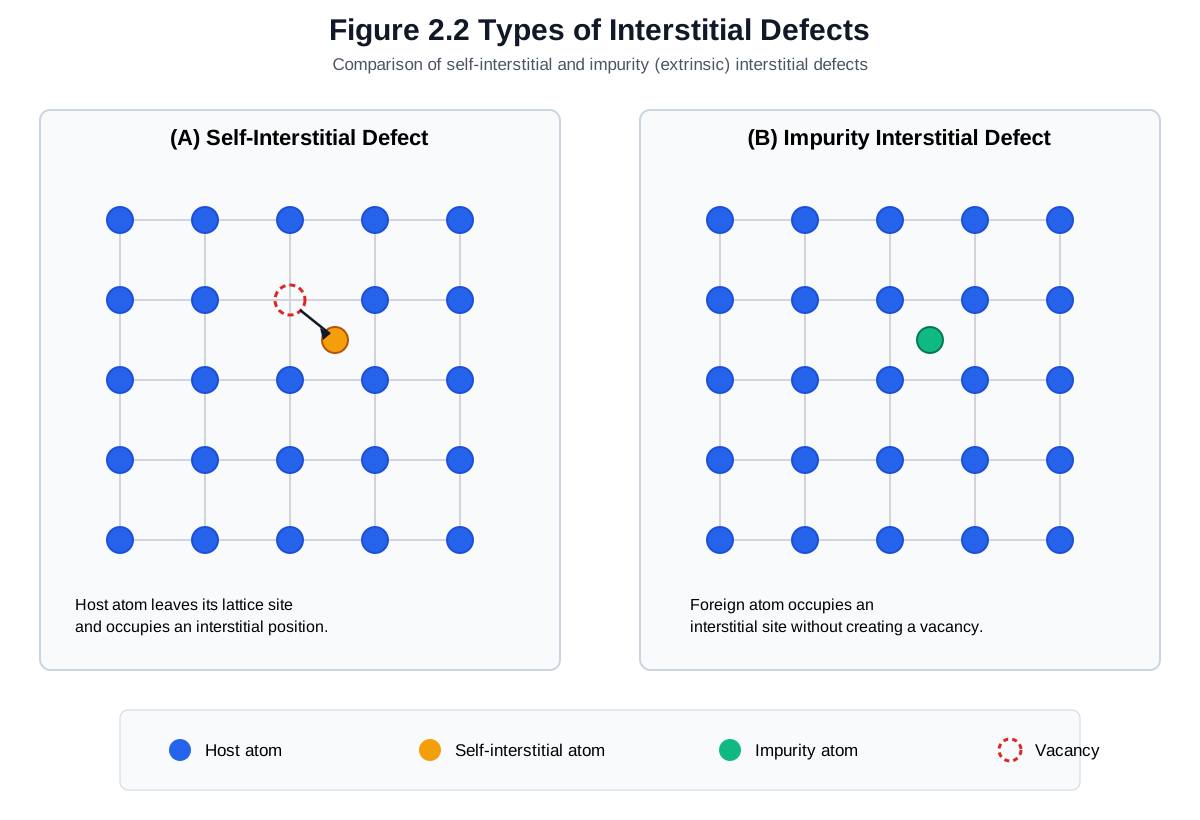
Formation of Interstitial Defect
Interstitial defects may arise during crystal growth, plastic deformation, irradiation, rapid cooling, or high-temperature treatment. They may also be produced when small impurity atoms diffuse into the crystal and occupy the available interstitial spaces. In some crystals, particularly under energetic conditions, a host atom may be displaced from its normal lattice position into a neighbouring interstitial site, resulting in the formation of a self-interstitial defect.
Types of Interstitial Defects
Self-Interstitial Defect
In a self-interstitial defect, an atom belonging to the crystal itself leaves its normal lattice position and occupies an interstitial site. Consequently, two point defects are produced simultaneously: a vacancy at the original lattice site and an interstitial atom at the new position. The surrounding atoms are displaced slightly, producing local lattice distortion and increasing the elastic strain energy of the crystal.
Impurity (Extrinsic) Interstitial Defect
In an impurity interstitial defect, a foreign atom enters the crystal from outside and occupies an interstitial site without displacing any host atom. Since no lattice atom is removed from its original position, a vacancy is not produced. This type of defect is common in alloys and engineering materials containing small impurity atoms.
Characteristics of Interstitial Defect
Interstitial defects increase the number of particles present in the crystal lattice and produce local distortion because the interstitial atom occupies a space smaller than its normal atomic size. The magnitude of distortion depends on the size of the interstitial atom and the crystal structure. These defects generally introduce considerable internal stress and strain, thereby affecting the physical properties of the material.
Effect on Physical Properties
Interstitial defects significantly influence the mechanical, electrical, thermal, and diffusion properties of crystalline solids. The lattice distortion caused by interstitial atoms obstructs the movement of dislocations, thereby increasing the hardness, strength, and wear resistance of metals. They also affect atomic diffusion, electrical conductivity, and ionic transport in crystalline materials.
Examples
- Carbon atoms occupying interstitial sites in iron (steel).
- Hydrogen atoms dissolved in palladium.
- Nitrogen atoms occupying interstitial sites in iron.
- Boron atoms in silicon.
- Self-interstitial silicon atoms produced by irradiation.
Importance of Interstitial Defects
Interstitial defects play an essential role in metallurgy, semiconductor technology, ceramic engineering, and materials science. They are responsible for interstitial strengthening in alloys, influence diffusion-controlled processes, and are important in the design of battery materials, hydrogen storage systems, catalysts, and electronic devices. Understanding interstitial defects also provides the foundation for studying the Frenkel defect in ionic crystals.
Summary
An interstitial defect is a point defect in which an atom or ion occupies an interstitial site between the normal lattice positions. The interstitial atom may be either a foreign impurity or a host atom displaced from its original lattice position. In the latter case, both a vacancy and an interstitial atom are formed simultaneously, and in ionic crystals this defect is known as the Frenkel defect. Interstitial defects produce lattice distortion and strongly influence the mechanical, electrical, and diffusion properties of crystalline solids.