Many ionic crystals contain point defects that preserve electrical neutrality while altering the arrangement of ions within the crystal lattice. One of the most important intrinsic point defects found in ionic solids is the Schottky defect. This defect is named after the German physicist Walter H. Schottky, who first explained its occurrence in ionic crystals.
A Schottky defect is produced when an equal number of cations and anions are missing from their normal lattice positions. The simultaneous absence of oppositely charged ions maintains the overall electrical neutrality of the crystal. Since only lattice sites are left vacant and no ions occupy interstitial positions, the crystal structure remains largely unchanged, although its density decreases slightly.
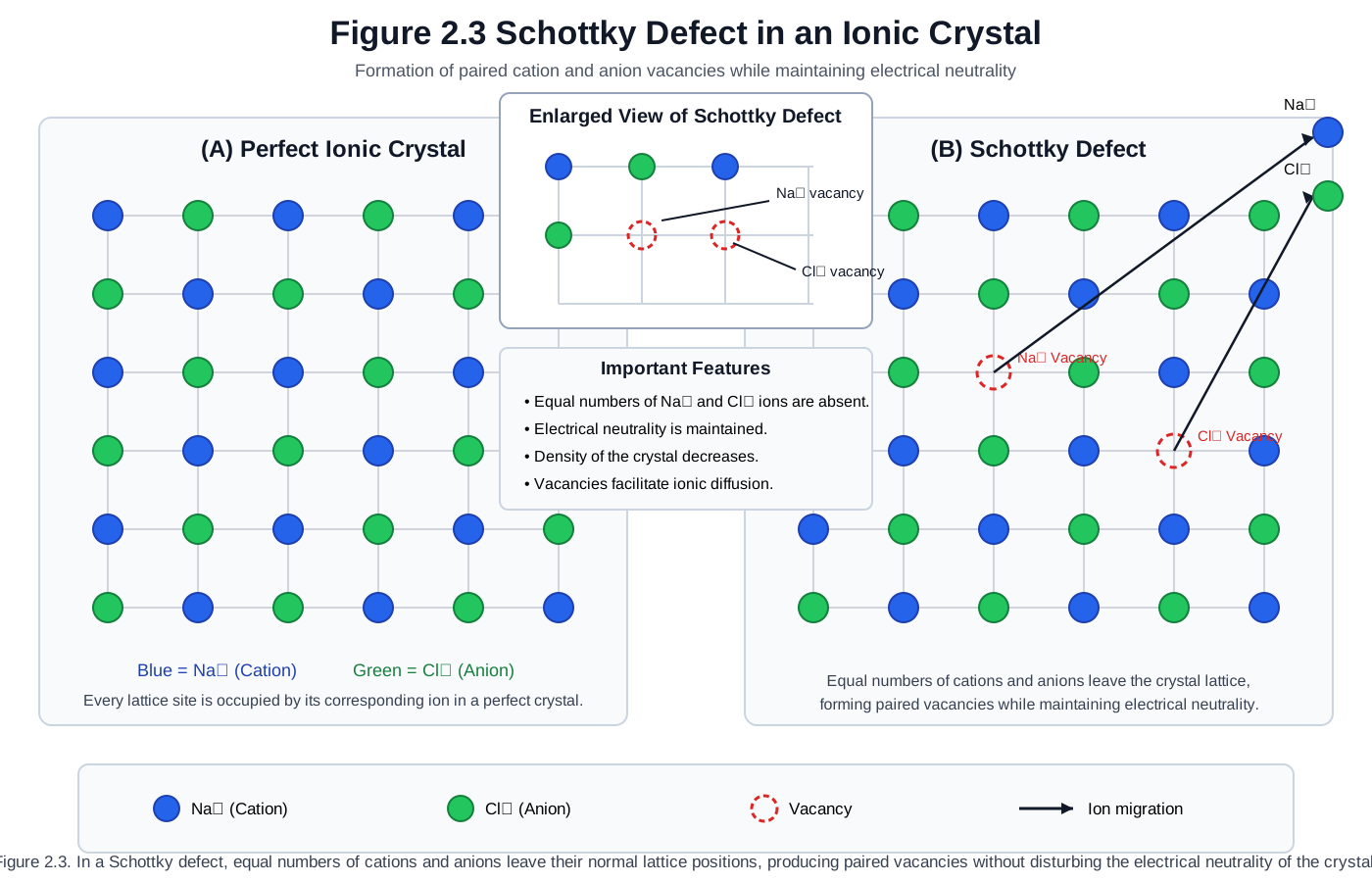
Formation of Schottky Defect
During crystal growth or at elevated temperatures, ions acquire sufficient thermal energy to leave their normal lattice positions. To preserve electrical neutrality, a cation and an anion leave the crystal simultaneously, usually migrating to the surface of the crystal. Their departure creates a pair of vacant lattice sites known as a Schottky defect. Since both ions are removed in equal numbers, no net electrical charge is produced.
Mechanism of Formation
Initially, every cation and anion occupies its designated lattice position in a perfectly ordered ionic crystal. When thermal energy increases, one cation and one neighbouring anion leave the crystal lattice. The vacant cation site and vacant anion site together constitute a Schottky defect. Because the crystal loses ions without any appreciable change in volume, the density of the crystal decreases.
Characteristics of Schottky Defect
The Schottky defect is an intrinsic point defect that occurs mainly in highly ionic crystals having cations and anions of nearly comparable size and high coordination numbers. The defect consists exclusively of vacancies and does not involve interstitial ions. Electrical neutrality is always maintained because equal numbers of positive and negative ions are absent from the crystal.
Effect on Physical Properties
The presence of Schottky defects lowers the density of ionic crystals because ions are removed from the lattice while the crystal dimensions remain almost unchanged. These defects also enhance ionic diffusion and contribute to ionic conductivity, particularly at elevated temperatures. Since vacancies provide pathways for ion migration, Schottky defects are important in diffusion-controlled processes and solid-state reactions.
Examples of Schottky Defect
- Sodium chloride (NaCl)
- Potassium chloride (KCl)
- Potassium bromide (KBr)
- Cesium chloride (CsCl)
These ionic crystals possess cations and anions of similar size, making the formation of paired vacancies energetically favourable.
Importance of Schottky Defect
The Schottky defect plays a vital role in defect chemistry and materials science. It influences ionic conductivity, diffusion, sintering, crystal growth, and the high-temperature behaviour of ionic solids. Understanding Schottky defects is essential for studying ceramic materials, solid electrolytes, fuel cells, and ionic conductors.
Summary
A Schottky defect is an intrinsic point defect in which equal numbers of cations and anions are absent from their normal lattice positions. The defect maintains electrical neutrality, decreases crystal density, and increases ionic diffusion and conductivity. It is commonly observed in highly ionic crystals such as sodium chloride, potassium chloride, potassium bromide, and cesium chloride.