A pressure-spring thermometer is a temperature-measuring instrument in which the temperature is determined from the pressure developed by a thermometric fluid contained in a closed system. The pressure produced by the fluid changes with temperature and is transmitted through a flexible mechanical element such as a Bourdon tube, diaphragm, or bellows. The resulting mechanical movement is amplified and indicated by a pointer on a calibrated temperature scale.
Principle
The working principle of a pressure-spring thermometer is based on the change in pressure of a confined thermometric fluid with change in temperature. When the temperature of the sensing bulb increases, the pressure of the fluid inside the closed system increases. This pressure acts on the pressure-sensitive element and causes it to deform. The deformation is transmitted through a mechanical linkage to a pointer, which moves over a calibrated temperature scale.
For a gas-filled system, the pressure-temperature relationship at constant volume can be represented approximately by:
\[P \propto T\]
or
\[\frac{P_1}{T_1}=\frac{P_2}{T_2}\]
where \(P_1\) and \(P_2\) are the pressures at temperatures \(T_1\) and \(T_2\), respectively, and the temperatures are expressed on an absolute temperature scale.
Construction
A pressure-spring thermometer consists of a temperature-sensitive bulb, a capillary tube, a pressure-sensitive spring element, a mechanical linkage, a pointer, and a calibrated temperature scale. The bulb is placed at the location where temperature is to be measured. The bulb, capillary tube, and pressure-sensitive element form a closed system containing the thermometric fluid.
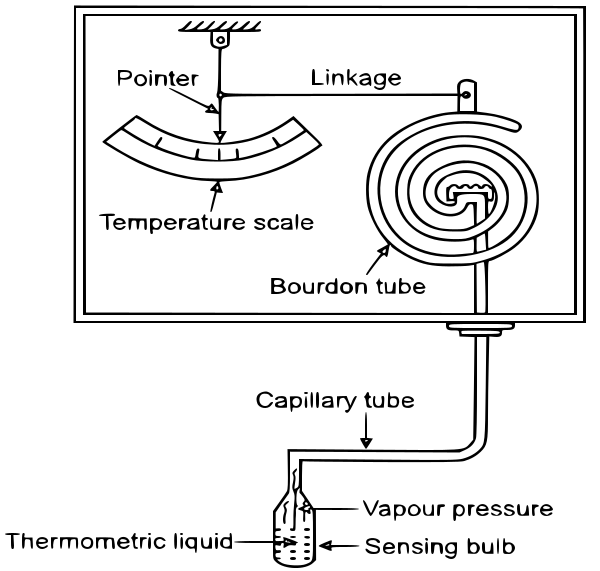
1. Sensing Bulb
The sensing bulb is the temperature-sensitive part of the instrument. It is placed in contact with the substance whose temperature is to be measured. The bulb contains the thermometric fluid and transfers the temperature change to the fluid inside the closed system.
2. Capillary Tube
The sensing bulb is connected to the pressure-sensitive element through a narrow capillary tube. The capillary allows the pressure developed in the sensing bulb to be transmitted to the indicating mechanism while permitting the bulb to be installed at a distance from the instrument.
3. Thermometric Fluid
The closed system is filled with a suitable thermometric fluid. Depending on the type of pressure thermometer, the filling may be a gas, vapour, or liquid. The fluid is selected according to the required temperature range and the desired response characteristics.
4. Pressure-Sensitive Element
The pressure-sensitive element is a flexible mechanical element that responds to the pressure developed by the thermometric fluid. A Bourdon tube is commonly used for this purpose. The pressure causes the element to deform or change its shape, producing a mechanical displacement.
5. Mechanical Linkage
The movement of the pressure-sensitive element is transmitted through a system of levers, links, and gears. This mechanism converts the relatively small displacement of the pressure-sensitive element into a larger angular movement suitable for operating the pointer.
6. Pointer and Graduated Scale
The mechanical linkage is connected to a pointer that moves over a calibrated temperature scale. The position of the pointer gives the temperature of the substance being measured.
Working
When the sensing bulb is exposed to a change in temperature, the temperature of the thermometric fluid inside the closed system changes. This produces a corresponding change in the pressure of the fluid. The pressure is transmitted through the capillary tube to the pressure-sensitive element.
The pressure causes the pressure-sensitive element to deform. This deformation is transferred through the mechanical linkage and converted into angular movement of the pointer. The pointer moves over the calibrated scale and indicates the corresponding temperature.
When the temperature decreases, the pressure of the thermometric fluid decreases and the pressure-sensitive element moves in the opposite direction. The pointer consequently moves toward a lower temperature indication.
Temperature change → Pressure change of thermometric fluid → Deformation of pressure-sensitive element → Mechanical linkage movement → Pointer movement → Temperature reading
Types of Pressure-Spring Thermometers
1. Gas-Filled Thermometer
A gas-filled thermometer uses a gas as the thermometric fluid. When the temperature changes, the pressure of the confined gas changes and produces movement of the pressure-sensitive element. Gas-filled thermometers can be used over a relatively wide temperature range.
2. Vapour-Pressure Thermometer
A vapour-pressure thermometer contains a volatile liquid and its vapour in the sensing system. The vapour pressure changes strongly with temperature. This pressure change is transmitted to the pressure-sensitive element and is converted into a temperature indication.
3. Liquid-Filled Thermometer
A liquid-filled thermometer uses a liquid as the thermometric fluid. Temperature change causes the liquid to expand, producing a pressure change in the confined system. The resulting pressure acts on the pressure-sensitive element and produces the temperature indication.
Advantages
- Can measure temperature from a distance.
- The sensing bulb can be installed in locations that are difficult to access.
- No electrical power is required for mechanical indication.
- Suitable for industrial temperature measurement.
- Can provide direct indication on a calibrated scale.
- Suitable for relatively high-temperature applications depending on the filling fluid and construction.
Limitations
- Capillary length can affect the accuracy of the instrument.
- Ambient temperature around the capillary can introduce errors.
- Mechanical linkages may introduce friction and hysteresis.
- The response may be slower than some electrical temperature sensors.
- The instrument requires proper calibration for accurate measurement.
- Damage to the sensing bulb or capillary can affect the measurement.
Applications
- Industrial process temperature measurement.
- Boilers and heating systems.
- Furnaces and ovens.
- Refrigeration systems.
- Petroleum and chemical processing equipment.
- Temperature measurement in tanks and pipelines.